
The 3 Types of Weight You Lose on GLP-1 (and Why the Scale Fluctuates)
Understanding water weight, glycogen, and fat loss helps explain why daily scale fluctuations are normal and why focusing on trends matters more than daily numbers.
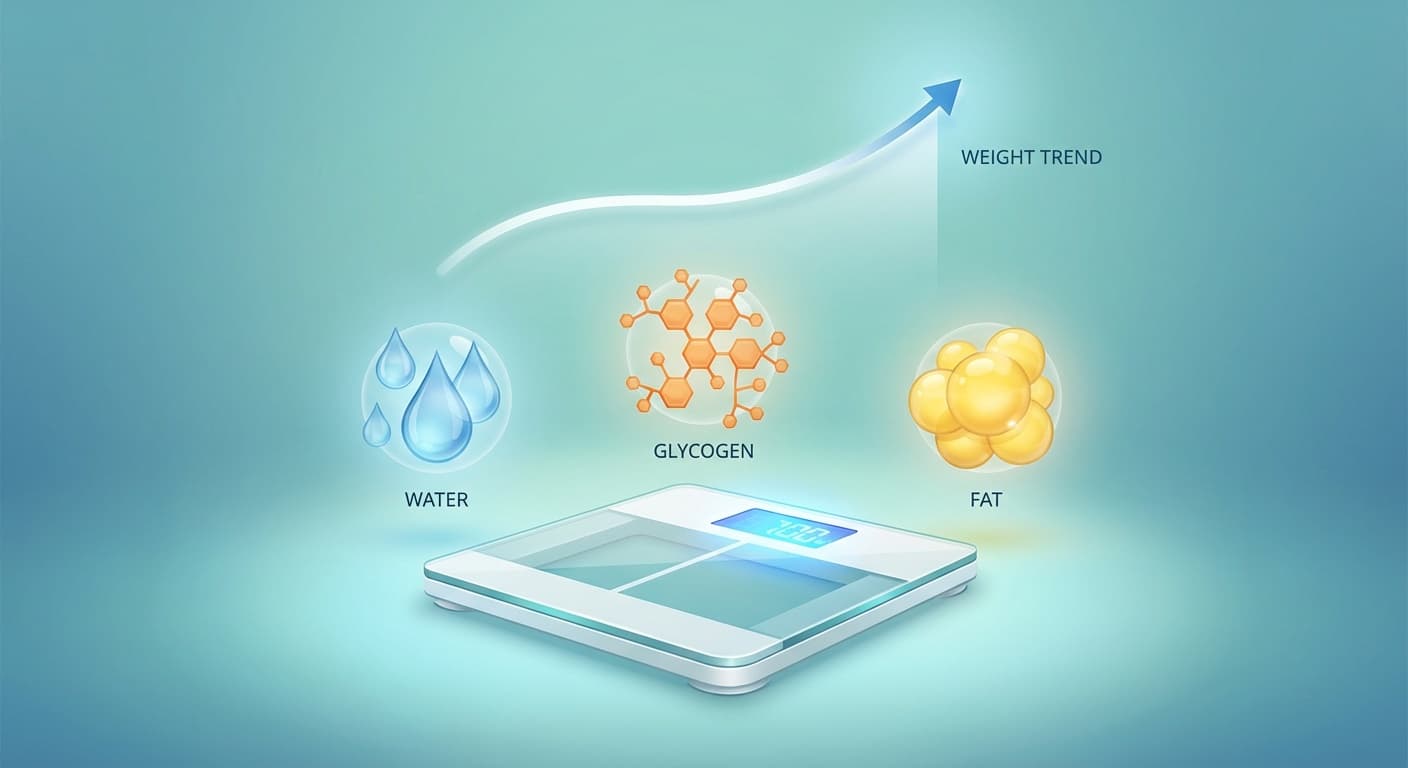
When you're on a GLP-1 medication for weight loss, stepping on the scale can be an emotional rollercoaster. Some days it drops, other days it jumps up for no apparent reason. As one weight-loss expert points out, "The scale is a horrible barometer of behavior change" – you can eat right and exercise, "but then you get on the scale, and you're up 2 pounds."1 Don't panic: this daily turbulence is normal and doesn't mean your efforts failed. Your body weight is a combination of different things (not just fat), and understanding the three types of weight you lose on GLP-1 will help you see why day-to-day scale changes are mostly noise. In fact, even a healthy person's weight can swing by about 5 to 6 pounds in a single day just from these non-fat factors.2 The real progress comes from long-term fat loss, while short-term ups and downs usually boil down to changes in water weight, glycogen, or actual fat. Below, we'll break down each of these and explain why focusing on the trend (not the daily number) is key to tracking success.
Water Weight: Quick to Change, But Temporary
Water weight refers to the fluid content your body is holding at any given time. Because about 60–80% of our body is water, even small shifts in hydration can move the scale noticeably.3 It's entirely normal for your weight to fluctuate by a few pounds in a day mainly due to changes in body water.4 Short-term weight changes are usually caused by gaining or losing water – not actual fat tissue.5
Several everyday factors affect water retention. For instance, a high-sodium meal (salty food) or a lot of carbohydrates can make your body temporarily hold onto extra water. After a carb-rich or salty dinner, you might weigh more the next morning because your body retained fluid to balance the salt and store the carbs.6 This kind of water-weight gain is temporary and often comes with a bloated feeling. Hormonal shifts (like those during the menstrual cycle) and certain medications can also cause you to retain water and see a higher number on the scale for a short time.7 On the flip side, you might suddenly drop weight after heavy sweating (say, from an intense workout or sitting in a sauna) – but that's just water lost through sweat, which will come back when you rehydrate.8 Even not drinking enough water can paradoxically make your body hold on to fluid (a dehydration response).9
The key thing to remember is that water weight changes do not reflect fat loss or gain. They're essentially shifts in your body's water balance. You can lose a lot of "weight" quickly by shedding water, but that's not the same as losing fat. For example, if you drastically cut your sodium or do a low-carb diet, you might drop a few pounds within days due to water loss. However, that weight can come back just as quickly if you reintroduce salt, carbs, or even just rehydrate. Yes, water weight is real weight on the scale, but it's not fat – it's a temporary fluctuation tied to diet, hydration, and hormones.10 The good news is that on a GLP-1 regimen, some early weight loss will be water (especially if your eating habits change to include less junk food), but this is expected. Don't be discouraged by these quick changes, positive or negative. Water weight comes and goes, and everyone carries some water weight variability day to day.
Glycogen Weight: Your Carb Stores and "Fast" Pounds
Glycogen is your body's stored carbohydrate, mostly found in your liver and muscles. It's essentially chains of glucose that your body keeps in reserve for energy. A crucial thing about glycogen is that it binds water – a lot of it. Each gram of glycogen is stored with about 3–4 grams of water.11 This means glycogen can be a significant source of weight fluctuation. When your glycogen stores change, your weight changes because of the water attached.
Think about what happens when you start a diet or begin GLP-1 therapy and you're eating fewer calories (and often fewer carbs) than before. Your body will quickly begin to tap into its glycogen reserves for energy. As it burns through glycogen, it also releases the water that was stored with it. The result? A rapid drop on the scale in the first week or two. This is the classic "water weight" loss that happens at the beginning of many diets.12 You might notice, for example, that you lose a few pounds in the very first days of your weight-loss journey – that's largely your glycogen being depleted and dumping water. One medical review notes that cutting carbohydrate intake causes the body to use up glycogen and release a lot of water, visibly reducing bloating and making the scale drop quickly. In other words, early weight loss is often glycogen weight loss. It's real weight, but it's not fat – and it tends to plateau once your body's glycogen stores reach a lower steady state.
On the flip side, glycogen is also why an indulgence can cause a sudden scale jump. Have you ever eaten a very carb-heavy meal (think a big pasta dinner) or had a high-carb weekend and then noticed you're a few pounds heavier the next day? You didn't gain 3 pounds of fat overnight – your body simply stored more glycogen and water. For every gram of carbs you ate that turned to glycogen, your body kept 3+ grams of water with it.13 Studies show this effect clearly: after a high-carb day, your weight can spike from the extra water your body retains to store those carbs. This is normal and will reverse once you go back to your usual eating; the extra water will flush out as glycogen levels fall. It's the reason low-carb diets often seem to have dramatic results in the first week – people are losing glycogen and its associated water. Dr. Garth Davis, a weight loss specialist, points out that when you go on a low-carb regimen, "you lose the water stored with [glycogen]… That's why the scale often drops quickly at the start" of such diets.14 The same principle can apply on GLP-1: if you're eating less overall (and a bit less carb than before), you'll likely see an early dip on the scale from glycogen loss. Just remember, this is not fat loss – it's an early adjustment in your fuel stores.
To summarize glycogen's role: it's your body's carb bank, and it comes with a lot of water. When the bank balance goes down (glycogen used up), you shed water weight; when it goes up (glycogen refilled), you add water weight. These changes can happen fast – within days – and can swing your scale weight by several pounds. Glycogen weight is an important concept because it explains why the first pounds come off fast and why you might see a quick bump up after a high-carb day. Understanding this prevents confusion and panic over those sudden scale changes.
Fat Weight: The Real Goal (Slow and Steady)
Lastly, we come to fat weight – the weight we actually want to lose for long-term health and fitness. Fat loss is the slowest and most meaningful form of weight loss. Unlike water or glycogen, your body can't change the amount of fat it carries overnight. Burning off body fat takes a sustained calorie deficit over time. Roughly speaking, to lose one pound of fat, you need to burn about 3,500 more calories than you eat (though this can vary by individual). In practical terms, that means even a solid fat-loss rate of 1–2 pounds per week is a steady process – nothing you'll detect from one day to the next on a scale. This is why fat-related weight loss is much slower than water weight loss.15 You might drop several pounds of water/glycogen in a week, but you won't drop several pounds of pure fat in a week without extreme measures.
GLP-1 medications (like semaglutide, liraglutide, etc.) facilitate fat loss by curbing your appetite so you naturally eat fewer calories. Over weeks and months, this calorie reduction translates to your body burning stored fat for energy. Clinical studies of GLP-1 therapy confirm that the weight people lose is primarily from body fat rather than lean tissue.16 That's good news – it means these medications are doing what they're meant to (reducing excess adipose tissue). For example, in trials of semaglutide for obesity, the majority of the weight lost was fat mass. However, it's important to note that no weight loss method strips off only fat; there's always some loss of lean mass (which includes muscle, water, and glycogen). In fact, research finds that with GLP-1 treatments, about 15–40% of the total weight lost can come from lean body mass (everything that isn't fat).17 A portion of that is the glycogen and water we discussed, and some can be muscle tissue.
Loss of muscle might sound alarming, but it's a common aspect of weight loss in general – any time you lose a significant amount of weight, some muscle can go with it (especially if you're not doing resistance training). The good news is you can minimize muscle loss with the right strategies. Regular strength-training exercise and adequate protein intake help signal your body to hold on to muscle even as you lose weight.18 So, while some muscle loss is inevitable on any diet, it can be mitigated. If you're on GLP-1 therapy, consider incorporating light strength exercises or protein-rich foods to support your lean mass. Overall, though, the vast majority of what's coming off on the scale over the long term is fat, which is exactly what we want to improve health. Patience is key: fat loss is a gradual process, in contrast to the rapid but fleeting shifts of water and glycogen. Trust that if you maintain healthy habits (and your GLP-1 treatment), your body will chip away at the fat stores consistently over time.
Why the Scale Fluctuates: Separating Noise from Progress
By now it should be clear that your body weight is influenced by multiple components. Day-to-day weight changes mostly reflect water and glycogen shifts, not actual fat gain or loss. It's crucial to separate this daily "noise" from true fat-loss progress. Let's recap the common reasons your scale may swing up or down within short periods (none of which mean you've ruined your diet or gained fat overnight):
-
Carbohydrate Intake: Eating more carbs than usual causes your body to store extra glycogen, and with it extra water. This can make you weigh heavier the next day.19 Conversely, cutting back on carbs (even temporarily) lets your body shed water as glycogen is used up, making your weight drop quickly. These changes are glycogen/water swings – not changes in body fat.
-
Salt and Sodium: A salty meal can lead to water retention. Your body holds water to keep the salt concentration in balance, resulting in a higher weigh-in until the excess sodium is flushed out.20 Just eating restaurant food or processed snacks (often high in sodium) one day can make you retain water and bump up your weight, even though you haven't gained fat.
-
Food Weight in Digestion: The amount of food and liquid in your digestive tract adds to your scale weight temporarily. If you ate a large dinner late last night, that food (plus fluids) is still inside you this morning, counting toward the scale number until it's fully digested and eliminated. Everything you consume has weight, so a big meal can cause a short-term uptick on the scale.21 This isn't fat – it's just the physical weight of what's in transit through your body.
-
Hydration and Sweat: Your water intake and output can shift your weight. For example, if you weigh yourself after an intense workout or sauna, you might be lighter due to sweat loss (water loss). On average, an hour of moderate exercise can make you lose about a liter of water (around 1 kg or 2.2 lbs) through sweat.22 Of course, once you rehydrate by drinking fluids, that weight comes back. Similarly, not drinking enough water can trigger your body to hold onto fluid (to prevent dehydration), which might make your weight higher until you hydrate properly.
-
Hormonal Fluctuations: Hormones influence water balance. A classic example is the menstrual cycle – it's common for women to gain 1–4 pounds of water weight in the days before their period due to hormone-driven fluid retention.23 These pounds will naturally disappear the following week. Other hormonal changes (stress hormones, etc.) can also cause water retention or shifts in where fluid is stored in the body. Again, these are temporary changes in water, not fat tissue.
There are other factors too – for instance, certain medications can cause water retention or appetite changes, and even constipation can make you weigh more until relief comes.24 But the points above are the most frequent causes of day-to-day weight variability.
The main takeaway is that none of these daily fluctuations are due to gaining or losing body fat. They are normal physiological changes. As one research review explains, "All of these fluctuations are normal, and they're not indicative of significant changes in our body fat or muscle mass."25 In other words, the extra 2 pounds you see after a weekend of indulgence is not 2 pounds of new fat – it's likely just water retained from higher carbs, salt, and a heavier food load. Likewise, dropping 3 pounds in two days from a low-carb kick doesn't mean you burned 3 pounds of fat; you mostly lost water. Recognizing this helps you stay calm and stick to your plan, rather than getting demotivated or overreacting to every scale reading.
Conclusion: Focus on the Trend
Since daily weights bounce around for all sorts of reasons, the true measure of success is the long-term trend. Are you gradually decreasing over weeks and months? That is what reflects fat loss. If so, it doesn't matter if your weight was up today – what matters is that it's lower on average this month than last month. Health experts recommend zeroing in on these trends rather than the day-to-day noise. "Don't panic over short-term changes – focus on long-term patterns, not day-to-day fluctuations," advises Dr. Davis.26 One strategy to do this is to weigh yourself under consistent conditions (for example, every morning after using the bathroom) and look at your weekly average or trend line instead of yesterday vs. today. Research shows that weekly weigh-ins can be sufficient to track progress because they smooth out mid-week ups and downs.27 In fact, weighing too often without understanding fluctuations can lead to unnecessary stress, whereas monitoring your weight trend over time gives a clearer picture of true change.
Our app Glip is built around this principle. We know how important it is to see the signal (fat loss) through the noise (water/glycogen shifts). That's why Glip uses an advanced smoothing algorithm – Holt's linear trend method – on your weight entries to filter out daily volatility. This statistical technique takes your daily weigh-in data and produces a smooth trend curve that reflects your underlying weight loss trajectory. In simple terms, it's like a moving average, but more sophisticated in handling trends. The result is that you see your real progress without being misled by every little spike or dip. For example, if you're steadily losing fat at ~2 pounds per week, the trend line will slope downward at that pace even if one day's reading was higher because of yesterday's salty dinner. By contrast, a sudden water-weight jump won't send your trend line spiking – it'll barely register because the algorithm knows it's likely noise. This helps you stay focused and motivated. As Dr. Leslie Heinberg from Cleveland Clinic suggests, it's useful to record your weights and "follow trends over time" – if you notice your trend creeping up for several weeks, you can adjust your plan, but "the scale can't always tell the whole story" in a single day.28 Glip's predictive Holt method takes that approach to the next level by even forecasting your future weight trajectory based on the trend, giving you a realistic goal outlook.
Bottom line: trust the trend, not any one weigh-in. Daily numbers will jump around due to water and glycogen, but if you're in a calorie deficit (with help from your GLP-1), over time the trend will be downward. True fat loss reveals itself in those multi-week trends, not in ephemeral day-to-day changes. So next time the scale inexplicably goes up a pound, take a deep breath and remember it's likely just water or yesterday's carbs – not a reversal of your fat loss. Stick to your plan, use tools like trend smoothing or weekly averages, and you will see the real progress. Day-to-day fluctuations are just noise; the long-term trend is the signal of success. And with GLP-1 therapy and smart tracking on your side, that signal will keep pointing downwards towards your goal weight.
References
Footnotes
-
Heinberg, L. (2024). "The scale is a horrible barometer of behavior change." Why Does My Weight Fluctuate So Much? Cleveland Clinic Health Essentials. https://health.clevelandclinic.org/weight-fluctuations ↩
-
Cleveland Clinic. Even for people within a healthy weight range, daily weight can fluctuate by 5-6 pounds based on diet and physical activity. https://health.clevelandclinic.org/weight-fluctuations ↩
-
Houston Methodist. "About 60-80% of our body is water." What Is Water Weight? https://www.houstonmethodist.org/blog/articles/2025/jul/what-is-water-weight-and-should-you-be-trying-to-lose-it/ ↩
-
Cleveland Clinic. "Yes, it's entirely normal for your weight to fluctuate." https://health.clevelandclinic.org/weight-fluctuations ↩
-
Cleveland Clinic. "Daily fluctuations of a few pounds are common and mostly due to fluid shifts." https://health.clevelandclinic.org/weight-fluctuations ↩
-
Cleveland Clinic. After a meal high in sodium or carbohydrates, the body retains fluid to balance salt and store carbs. https://health.clevelandclinic.org/weight-fluctuations ↩
-
Fuller, N. (2024). The type of food we've consumed affects water retention. How often should you really weigh yourself? University of Sydney. https://www.sydney.edu.au/news-opinion/news/2024/07/09/how-often-should-you-really-weigh-yourself-.html ↩
-
Cleveland Clinic. Hormonal shifts and medications can cause temporary water retention. https://health.clevelandclinic.org/weight-fluctuations ↩
-
Houston Methodist. High sodium, refined carbs, or dehydration can cause water retention. https://www.houstonmethodist.org/blog/articles/2025/jul/what-is-water-weight-and-should-you-be-trying-to-lose-it/ ↩
-
Houston Methodist. "Water weight can shift based on various factors from one day to the next." https://www.houstonmethodist.org/blog/articles/2025/jul/what-is-water-weight-and-should-you-be-trying-to-lose-it/ ↩
-
Fuller, N. (2024). Each gram of glycogen is stored with about 3-4 grams of water. University of Sydney. https://www.sydney.edu.au/news-opinion/news/2024/07/09/how-often-should-you-really-weigh-yourself-.html ↩
-
Everlywell Medical Team. (2024). "As you start your weight loss journey, the body rapidly sheds water weight by using up glycogen stores." Body Stages of Weight Loss. https://www.everlywell.com/blog/weight-management/body-stages-of-weight-loss/ ↩
-
Fuller, N. (2024). Studies show weight can spike after high-carb days from extra water retained to store carbs. University of Sydney. https://www.sydney.edu.au/news-opinion/news/2024/07/09/how-often-should-you-really-weigh-yourself-.html ↩
-
Houston Methodist. Dr. Garth Davis notes that on low-carb diets, "you lose the water stored with [glycogen]… That's why the scale often drops quickly at the start." https://www.houstonmethodist.org/blog/articles/2025/jul/what-is-water-weight-and-should-you-be-trying-to-lose-it/ ↩
-
Everlywell. "Fat-related weight loss is much slower than water weight loss." https://www.everlywell.com/blog/weight-management/body-stages-of-weight-loss/ ↩
-
Bikou, A. et al. (2024). Clinical trials show GLP-1 (semaglutide) weight loss is primarily from fat mass. Expert Opin. Pharmacother., 25(5). https://pubmed.ncbi.nlm.nih.gov/38629387/ ↩
-
American Diabetes Association. (2025). "Lean body mass typically accounts for 15-40% of total weight lost" on GLP-1 therapies. https://diabetes.org/newsroom/press-releases/new-glp-1-therapies-enhance-quality-weight-loss-improving-muscle-0 ↩
-
Everlywell. "While some muscle loss is inevitable, regular strength training and adequate protein intake help preserve muscle." https://www.everlywell.com/blog/weight-management/body-stages-of-weight-loss/ ↩
-
Fuller, N. (2024). Eating more carbs causes the body to store extra glycogen and water. University of Sydney. https://www.sydney.edu.au/news-opinion/news/2024/07/09/how-often-should-you-really-weigh-yourself-.html ↩
-
Fuller, N. (2024). "Our water content also increases after salty meals to dilute the excess salt." University of Sydney. https://www.sydney.edu.au/news-opinion/news/2024/07/09/how-often-should-you-really-weigh-yourself-.html ↩
-
Cleveland Clinic. Food intake and digestion contribute to temporary weight on the scale. https://health.clevelandclinic.org/weight-fluctuations ↩
-
Fuller, N. (2024). Exercise can cause water loss through sweat – about a liter per hour of moderate exercise. University of Sydney. https://www.sydney.edu.au/news-opinion/news/2024/07/09/how-often-should-you-really-weigh-yourself-.html ↩
-
Fuller, N. (2024). Hormonal changes during the menstrual cycle can cause 1-4 pounds of water weight gain. University of Sydney. https://www.sydney.edu.au/news-opinion/news/2024/07/09/how-often-should-you-really-weigh-yourself-.html ↩
-
Cleveland Clinic. "Weight fluctuation can be caused by medications and constipation." https://health.clevelandclinic.org/weight-fluctuations ↩
-
Fuller, N. (2024). "All of these fluctuations are normal, and they're not indicative of significant changes in our body fat or muscle mass." University of Sydney. https://www.sydney.edu.au/news-opinion/news/2024/07/09/how-often-should-you-really-weigh-yourself-.html ↩
-
Houston Methodist. Dr. Davis advises: "Don't panic over short-term changes – focus on long-term patterns, not day-to-day fluctuations." https://www.houstonmethodist.org/blog/articles/2025/jul/what-is-water-weight-and-should-you-be-trying-to-lose-it/ ↩
-
Fuller, N. (2024). Research shows weekly weigh-ins can smooth out normal fluctuations. University of Sydney. https://www.sydney.edu.au/news-opinion/news/2024/07/09/how-often-should-you-really-weigh-yourself-.html ↩
-
Heinberg, L. (2024). "Writing weight down can help follow trends over time" and "the scale can't always tell the whole story." Cleveland Clinic. https://health.clevelandclinic.org/weight-fluctuations ↩